
- Main page
- News
Baku Energy Forum: Azerbaijan opens a completely new strategic page in the development of the Caspian as an Energy Center
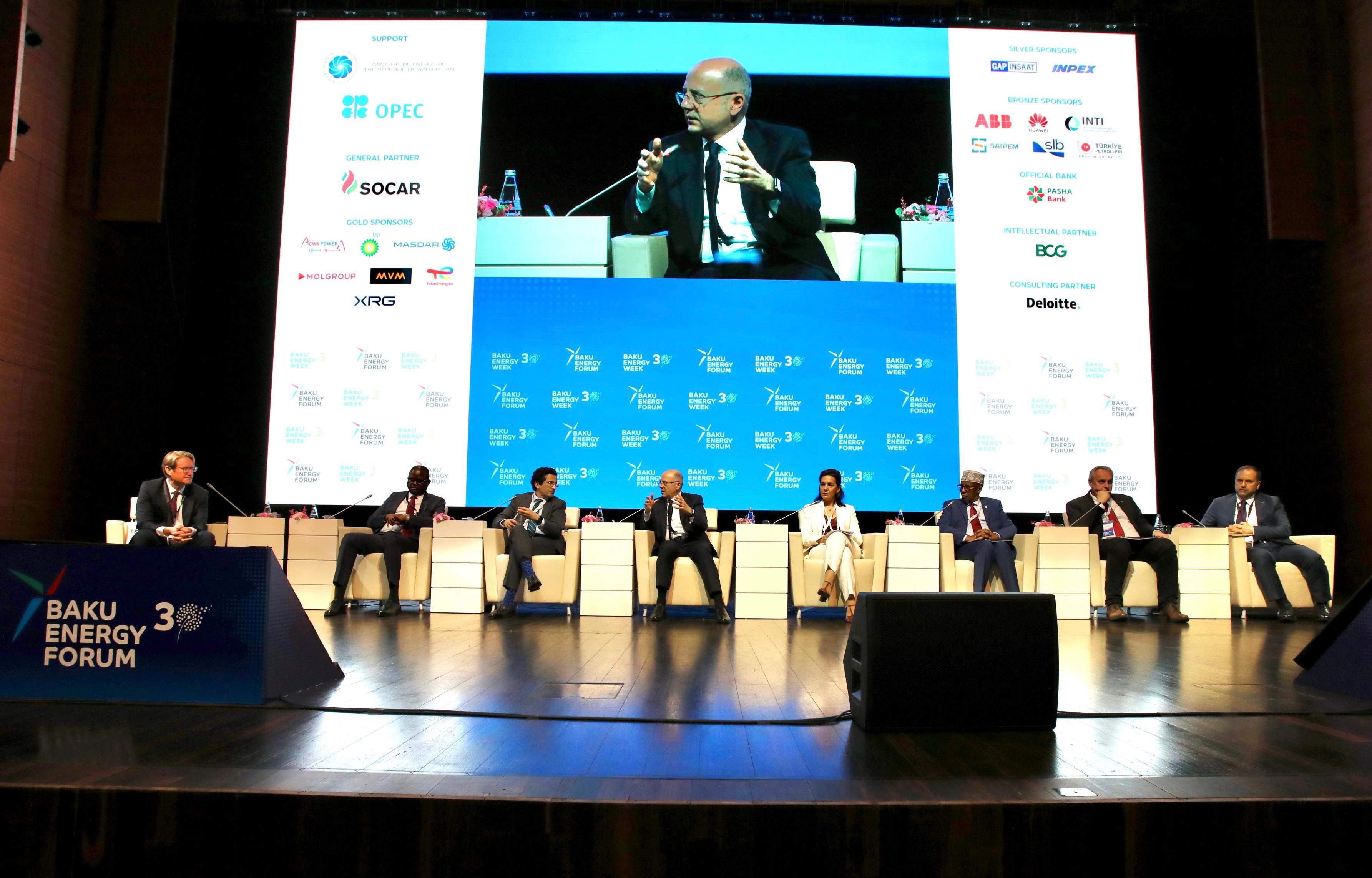
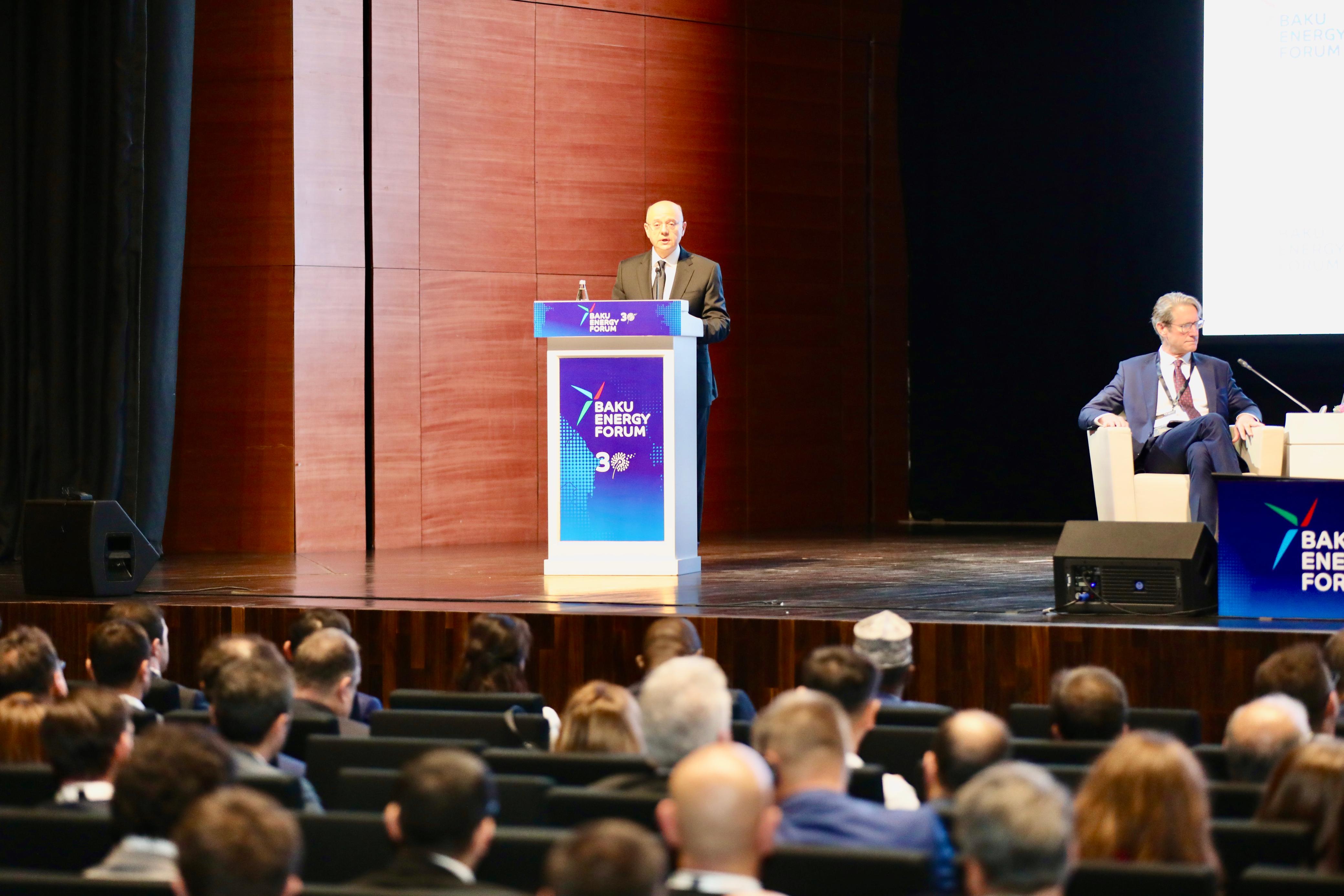
Energy Minister Parviz Shahbazov spoke at the Plenary Session on International Cooperation for Energy Security and Sustainability at the 30th Baku Energy Forum held within the Baku Energy Week.
It was noted in the speech that over the past 30 years, this platform has witnessed the wisdom of great leader Heydar Aliyev's policy aimed at sustainable energy independence and energy security, based on diversification, cooperation and far-sighted planning, the development of not only oil and natural gas, but also green energy projects and the expansion of international cooperation. Thanks to strategic projects such as the Baku-Tbilisi-Ceyhan, Baku-Tbilisi-Erzurum, and the Southern Gas Corridor — which connect the Caspian Sea to international energy markets — Azerbaijan today successfully exports oil to 25 countries and natural gas to 12 countries. The minister emphasizing that last year, more than 75% of Azerbaijan’s oil exports and 51% of its natural gas supply were directed to European countries said that Azerbaijan, which has taken a leading global position in terms of the geographic reach of gas transportation via pipeline in a short time, is now the fourth-largest supplier of pipeline gas to the European Union (EU), accounting for a 7% share: “This once again confirms that the rational and balanced approach of the President of the Republic of Azerbaijan, Ilham Aliyev, to all types of energy resources — along with his determined policy aimed at developing export infrastructure — has strengthened our country’s strategic position on the modern energy map and shaped a model of reliable energy security in an unstable world,” the minister added.
Five projects currently under development, as well as cooperation documents signed with TPAO, Exxon Mobil Corporation, MOL, ITOCHU and Gran Tierra Energy within the Baku Energy Week were brought to the attention. Integrating 2,700 MW of wind and solar energy into the national grid by the end of 2030 will save around 1.5 billion cubic meters of natural gas annually. The importance of increasing the transmission capacity of the transport infrastructures in the region, including the Southern Gas Corridor, and ensuring the necessary guarantees for the transportation of these volumes was emphasized.
It was noted that referring to the share of hydrocarbons in the global energy balance has changed by only about 5% over the past 30 years, it was highlighted that alternative energy sources do not replace existing ones but rather complement them. Given the continuing critical role of oil and gas, financing in this sector should not be postponed, and the diversification of energy sources, resources, trade routes, and supply chains must remain a constant priority. Now is the best time for investors to implement realistic and pragmatic policies that provide clarity and predictability, was said.
According to Parviz Shahbazov, saying that Azerbaijan has opened an entirely new strategic chapter in developing the Caspian into an energy hub through "green energy," he noted that the first phase of renewable energy development will be completed within the next two years with the commissioning of 10 solar and wind power plants. As part of this, a 240 MW wind power plant will be launched this year, and construction of three solar power plants with a total capacity of 200 MW will begin: “With these ‘green energy’ capacities, which have an investment value of $2.7 billion, the share of installed renewable energy capacity will reach 33.7% by 2027. Our plans are to increase this figure to 38% by 2030 and to 42.5% by 2035. Of the more than 6 GW of ‘green energy’ capacity to be developed onshore and offshore over the next five years, 4 GW will be intended for export. Additionally, at least 1 GW of the 6 GW renewable energy potential in the ‘green energy zone’ of Nakhchivan will be exported. In line with the strategic vision of the President of Azerbaijan aimed at securing the country's leading role in the supply and cross-border transmission of ‘green energy,’ large-scale ‘green energy corridors’ covering the Caspian basin, Central Asia, Türkiye, and Europe are currently being implemented. These corridors will transmit not only ‘green energy’ and hydrogen to Europe in the future but also data via fiber-optic cables.”
The speech also included information about green energy interconnectors Caspian-Black Sea-Europe, Central Asia-Azerbaijan, directly through Nakhchivan, as well as through the Zangezur corridor to Türkiye, and from there to Europe via Georgia. It was added that these strategic projects, covering the Caspian Sea, Central Asia, and the Middle Corridor, will contribute to the creation of a dynamic ecosystem that strengthens the region’s role in the modern energy security architecture and opens the path for long-term international cooperation.
.jpeg)
.jpeg)